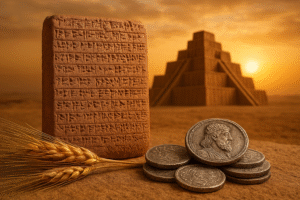
 In the cradle of civilization, where the Euphrates once mirrored the stars, the Babylonians built more than ziggurats and myths—they built an economy. Their financial practices, etched into clay tablets and sealed with divine oaths, offer enduring lessons on wealth, trust, and the sacred geometry of exchange. These ancient systems reveal a world where money was not merely transactional, but relational, symbolic, and deeply embedded in the rhythms of nature and society.
🪙 The Architecture of Babylonian Finance
Babylonian commerce thrived on a triad of principles: trust, time, and tangible value. Silver, barley, and livestock served as currency, but the true currency was reputation. Contracts were witnessed by gods, enforced by community, and recorded with meticulous care. Every transaction was a ritual, every repayment a return to balance.
The economy was not abstract. It was grounded in the physical and spiritual world. Silver was weighed, not counted. Loans were timed to harvests. Interest was not a tool of exploitation but a sacred exchange of risk and reward.
📜 The Code of Hammurabi: Law as Ledger
The Code of Hammurabi, carved around 1754 BCE, stands as one of the earliest legal and financial documents in human history. Among its 282 laws are detailed regulations on lending, interest, collateral, and default. Interest rates were capped—typically 20% for silver and 33% for grain. Collateral could include land, goods, or even family members in extreme cases.
These laws were not merely punitive; they were protective. They aimed to balance the scales between lender and borrower, ensuring that commerce did not devolve into exploitation. The code reflects a society that understood the power of finance to build or destroy, and sought to ritualize its use within a framework of justice.
🧿 The Seven Laws of Gold
Popularized in the 20th century by George S. Clason’s The Richest Man in Babylon, the so-called “Seven Laws of Gold” distill Babylonian financial wisdom into timeless principles:
- Save at least 10% of all income.
- Live below one’s means.
- Invest savings to generate returns.
- Avoid investments that seem too good to be true.
- Own a home to reduce living expenses.
- Prepare for future needs and emergencies.
- Continuously improve earning potential.
These principles reflect a culture that valued discipline, foresight, and the slow accumulation of wealth through steady, intentional action. They remain relevant in modern financial planning, offering a mythic framework for personal sovereignty and economic resilience.
🏛 Temples as Banks
Babylonian temples functioned as early financial institutions. The temple of Shamash at Sippar, among others, accepted deposits, issued loans, and recorded transactions. These were not secular banks but sacred spaces where economic activity was intertwined with religious ritual.
Promissory notes were inscribed on clay tablets, detailing the amount borrowed, the interest rate, and the repayment terms. These tablets were often sealed with cylinder seals—personalized carvings that left a unique impression in clay, serving as both signature and symbol.
The system relied on honor and memory rather than credit scores. Defaulting on a loan was not just a financial failure but a spiritual breach. Trust was the foundation, and reputation was currency.
🔄 Debt Forgiveness and Economic Renewal
One of the most radical aspects of Babylonian finance was the practice of periodic debt forgiveness. Known as amargi in Sumerian and misharum in Akkadian, these royal edicts wiped out personal debts, freed debt-slaves, and restored land to its original owners.
These resets were not acts of charity but of cosmic maintenance. They prevented systemic collapse, preserved social harmony, and reaffirmed the king’s role as a divine steward of justice. In a world where debt could lead to generational bondage, these edicts offered a ritual of renewal and a return to balance.
🔗 Doing Business in Babylon
Babylonian commerce was sophisticated and collaborative. Merchants formed partnerships, pooled capital, and shared profits. Contracts were detailed and witnessed, often invoking the gods to sanctify the agreement.
As noted in this article on doing business in Babylon, Babylonian business was based on trust, reputation, and the notion of interest rates. These principles governed not only local trade but also long-distance commerce, as Babylon sat at the crossroads of major trade routes connecting the Mediterranean, Persia, and the Indus Valley.
🧱 The Geometry of Contracts
Babylonian contracts were models of clarity and precision. Written in cuneiform on clay tablets, they included the names of all parties, the terms of the agreement, the collateral involved, and the penalties for default. Many were dated according to celestial events, aligning human affairs with cosmic rhythms.
These contracts were not bureaucratic formalities but ritual artifacts. They embodied the values of transparency, accountability, and sacred reciprocity. The act of inscribing a contract was both legal and liturgical—a binding of word, will, and witness.
🛖 Wealth as a Communal Force
In Babylon, wealth was not isolated. It flowed through families, temples, and guilds. The richest individuals were often those who taught others how to earn, save, and invest. Prosperity was seen as a communal good, not a private hoard.
This ethos of shared abundance is reflected in the educational tone of Babylonian financial texts. Wealth was not merely to be accumulated but to be understood, stewarded, and passed on. Teaching others to manage money was itself a form of wealth creation.
🔥 Lessons for the Modern World
The financial wisdom of ancient Babylon offers enduring insights for contemporary life:
- Ritualize income and savings: Treat money as a sacred resource, not a disposable commodity.
- Compost debt into renewal: Reframe financial setbacks as opportunities for reset and growth.
- Seal agreements with clarity: Whether in business or personal life, make commitments transparent and accountable.
- Teach and share: Wealth multiplies through education and empowerment.
- Anchor pricing in value and trust: Let economic exchange reflect mutual respect and shared benefit.
- Build partnerships: Embrace collaborative models of risk and reward.
- Create financial artifacts: Use tools and templates that embody clarity and intention.
- Honor tools and systems: Treat financial instruments as extensions of personal and communal agency.
- Embrace cycles of forgiveness: Allow space for renewal, both personal and systemic.
🌒 Conclusion: Finance as Myth and Method
Babylonian finance was not merely a precursor to modern economics. It was a holistic system that integrated law, ritual, and community. It treated wealth as a relational force, contracts as sacred texts, and debt as a cycle to be managed with justice and compassion.
In a world increasingly dominated by abstraction and automation, the financial practices of ancient Babylon offer a grounded, symbolic, and deeply human alternative. They remind us that money is not just math—it is myth, memory, and meaning.