 Most pricing advice sounds like math: calculate your costs, add a margin, test the market. But what if pricing could be more than transactional? What if it could be emotional, symbolic, and invitational?
Welcome to emotional pricing—a way of setting prices that doesn’t just ask “What’s it worth?” but instead asks, “What does this price invite?”
Whether you’re selling art, coaching, courses, music, or physical products, emotional pricing helps you align your offerings with the emotional journey of your audience. It’s not about manipulation or hype—it’s about resonance, clarity, and trust.
Let’s explore how it works.
💡 What Is Emotional Pricing?
Emotional pricing is the practice of setting prices based on the emotional signals they send—not just the financial value they represent.
It’s the difference between:
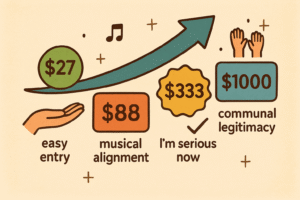
- $29 saying “easy entry”
- $88 whispering “musical alignment”
- $333 declaring “I’m serious now”
- $1000 marking “communal legitimacy”
Each price becomes a threshold, a symbol, a doorway. Instead of just selling a product, you’re inviting someone into a terrain—an experience, a transformation, a story.
🌀 Why Emotional Pricing Works
Humans don’t make decisions based on logic alone. We respond to:
- Symbolism: Numbers carry meaning. Think of 7 as mystical, 88 as musical, 108 as sacred.
- Emotion: A price can feel playful, serious, luxurious, or accessible.
- Identity: People buy things that reflect who they are—or who they’re becoming.
Emotional pricing taps into these layers. It helps your audience feel seen, understood, and invited—not just sold to.
🎯 Three Core Principles of Emotional Pricing
1. Price as Invitation
Instead of “Buy now,” your price becomes a message:
- “Step into this terrain.”
- “This is for you.”
- “You’re ready.”
For example, a $27 mini-course might say: “You don’t need to be perfect. Just begin.”
A $333 bundle might say: “You’re ready to commit. Let’s build something real.”
Each price tier becomes a threshold—not a demand.
2. Symbolic Anchors
Some numbers carry built-in resonance:
| Price | Symbolic Meaning | Possible Use |
|---|---|---|
| $7 | Mystical, playful | Intro offer, teaser |
| $27 | Accessible, casual | Mini-course, starter kit |
| $88 | Musical, aligned | Artistic bundle, creative relic |
| $108 | Sacred, complete | Spiritual or ritual offering |
| $333 | Serious, transformative | Coaching, deep-dive course |
| $1000 | Legacy, communal | Membership, full terrain access |
You can choose numbers that reflect your brand’s emotional tone. Are you playful? Grounded? Mythic? Let your prices echo that.
3. Layered Tiers
Emotional pricing works best when you offer multiple tiers, each with its own emotional arc.
Here’s a sample structure:
- Tier 1: $27 – Playful access. A mini-course, a single artwork, a short lesson. Low friction, high invitation.
- Tier 2: $88 – Expressive clarity. A bundle, a symbolic relic, a deeper experience.
- Tier 3: $333 – Serious transformation. A full course, coaching series, or immersive journey.
- Tier 4: $1000+ – Communal resonance. Membership, legacy access, co-creation.
Each tier invites a different kind of commitment. You’re not just selling—you’re guiding people through a symbolic journey.
🛠 How to Apply Emotional Pricing
Here’s a simple process to ritualize your own emotional pricing map:
Step 1: Name the Emotional Arc
What journey are you inviting people into? Is it playful exploration? Deep transformation? Communal resonance?
Write down the emotional stages of that journey. For example:
- Curiosity → Play → Commitment → Legacy
Step 2: Match Prices to Thresholds
Assign symbolic prices to each stage. Use numbers that feel emotionally congruent.
Example:
- Curiosity → $27
- Play → $88
- Commitment → $333
- Legacy → $1000+
You can adjust these based on your audience, your brand, and your terrain.
Step 3: Design the Offerings
Now build offerings that match each tier:
- $27 → A mini-course, a single artwork, a short creative lesson
- $88 → A bundle of expressive relics, templates, or symbolic tools
- $333 → A full course, coaching series, or immersive experience
- $1000+ → Membership, co-creation, or legacy access
Each offering should feel emotionally aligned with its price—not just in value, but in tone.
🧭 Emotional Pricing in Practice
Let’s say you’re a coach offering transformation journeys. Here’s how emotional pricing might look:
- $27 – “Starter Ritual Kit”
A playful, low-friction entry point. Just enough to spark curiosity. - $88 – “Creative Alignment Bundle”
A deeper dive into expressive clarity. Includes templates, exercises, and symbolic anchors. - $333 – “Transformation Arc”
A full journey. Weekly sessions, feedback, and emotional milestones. - $1000 – “Legacy Membership”
Access to all content, live sessions, and co-creation opportunities. A communal threshold.
Each price becomes a message. Each offering becomes a doorway.
🌱 Emotional Pricing for Artists, Teachers, and Creators
This works across domains:
- Artists: Price your prints or originals based on emotional resonance. $88 for a musical piece, $333 for a mythic relic.
- Teachers: Use symbolic tiers to guide students through learning. $27 for a teaser, $333 for a full arc.
- Course Creators: Build layered invitations. Let each price reflect a stage of growth or clarity.
You’re not just selling information—you’re inviting people into a terrain.
🔥 Final Thoughts: Price as Ritual
Emotional pricing isn’t about charging more or less. It’s about charging with intention.
When you treat pricing as ritual:
- You honor your audience’s emotional journey
- You align your offerings with symbolic clarity
- You build trust, resonance, and transformation
So next time you set a price, ask:
“What does this number invite?”
Let your prices become thresholds.
Let your offerings become altars.
Let your terrain speak.