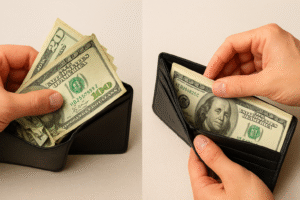
 Money is one of the most paradoxical forces in human life. It is at once ordinary and sacred, tangible and symbolic, a piece of paper and a vessel of power. How we treat money in its most physical form—whether a single dollar bill or a crisp fifty—reveals volumes about our deeper relationship with value, abundance, and self-respect.
This post explores the ritual of respecting money: how we place it in our wallets, how we invite it into our lives, and how those gestures echo into our financial reality.
🌿 The Physical Gesture: How We Place Our Bills
Imagine opening your wallet. Do the bills lie neatly, facing the same direction, stacked in order? Or are they crumpled, folded, shoved in without care?
- Neat placement: Aligning bills, smoothing them out, and facing them the same way is a gesture of order. It says: I value clarity. I honor what enters my life. I am a steward of resources.
- Careless storage: Tossing bills in randomly, letting them wrinkle or tear, suggests disregard. It may reflect unconscious resistance to wealth, or a belief that money is fleeting and unworthy of care.
- Inviting money in: Some people treat each bill as a guest. They place it carefully, acknowledge its presence, and even whisper gratitude. This transforms a mundane act into a ritual of abundance.
The wallet becomes not just a container but an altar. Each bill is an offering, each gesture a prayer.
🔮 Attitude Revealed: What Our Habits Say
Money is not conscious, but our habits around it shape our outcomes.
- Respect = stewardship: When we treat money with care, we are more likely to budget thoughtfully, invest wisely, and avoid waste. Respect breeds responsibility.
- Disorder = avoidance: If money feels messy in your wallet, it may reflect avoidance of financial clarity—like ignoring statements, delaying decisions, or fearing accountability.
- Gratitude = flow: Welcoming money with gratitude creates psychological openness. It shifts the mindset from scarcity to abundance, from fear to trust.
In this sense, the way we treat a single dollar mirrors how we treat larger sums. If we crumple a five, we may also squander opportunities. If we honor a fifty, we may also honor investments, partnerships, and long-term growth.
⚖️ How Money “Treats Us” in Return
Of course, money itself does not have feelings. But our relationship with it shapes how it flows through our lives.
- Respectful habits → attract stability. People who treat money with care tend to notice details, avoid leaks, and build resilience.
- Careless habits → invite chaos. Disorder in small gestures often echoes in larger financial patterns: overspending, missed opportunities, or financial stress.
Psychologists call this the microcosm effect: small behaviors reflect larger patterns. If you respect a single dollar, you are more likely to respect a paycheck, a savings account, or an investment portfolio.
✨ Money as Symbolic Ally
Beyond economics, money is symbolic. It represents energy, exchange, possibility. Treating it with respect is not superstition—it is a way of aligning with its symbolic power.
- A dollar can be seen as a seed: small, humble, but capable of growth.
- A fifty can be a pillar: strong, supportive, a foundation for stability.
- A hundred can be a guardian: protective, expansive, a sign of sovereignty.
Placing bills neatly is like arranging offerings on an altar. Each one is honored, each one reinforces your agency.
🌊 The Mythic Frame: Money as Ritual
For those who ritualize daily acts, money becomes a threshold. Every time you receive it, you cross into a new space of possibility. Every time you spend it, you release energy into the world.
- Receiving: Invite money in with gratitude. Smooth the bill, align it, acknowledge its presence.
- Storing: Keep your wallet clean, organized, intentional. Treat it as a sacred vessel.
- Spending: Release money with respect. Hand it over neatly, consciously, as if sending a friend on a mission.
This transforms money from a transactional tool into a mythic companion. It is no longer just paper—it is a witness to your values, a participant in your journey.
🌀 Psychological Resonance
Respecting money is not about superstition—it is about psychology.
- Order breeds confidence: When your wallet is neat, you feel more in control. That confidence echoes into financial decisions.
- Gratitude breeds abundance: When you thank money, you shift your mindset from scarcity to trust. This reduces anxiety and opens creative possibilities.
- Care breeds continuity: When you treat money well, you are less likely to lose it, waste it, or forget it.
In short: how you treat money shapes how you feel about money. And how you feel about money shapes how you use it.
🔥 Practical Rituals for Respecting Money
Here are some practices to embody respect:
- Align bills: Always face them the same way.
- Smooth wrinkles: Treat each bill as worthy of care.
- Order denominations: Place larger bills behind smaller ones, creating a sense of hierarchy and flow.
- Clean wallet: Remove clutter, receipts, or expired cards. Keep the space intentional.
- Gratitude pause: Each time you place money in your wallet, pause for a moment of thanks.
These small rituals create a larger pattern of respect, clarity, and abundance.
🌌 Beyond Money: Respect as a Universal Gesture
Ultimately, respecting money is part of a larger principle: respect for energy, resources, and life itself.
- If you respect money, you are more likely to respect time.
- If you respect money, you are more likely to respect relationships.
- If you respect money, you are more likely to respect yourself.
Money becomes a mirror. How you treat it reflects how you treat your own worth.
🧭 Conclusion: Money as Companion
So, how much do you respect money? When you place a dollar or fifty in your wallet, do you invite it with care? Do you align it, honor it, treat it as a guest?
These gestures may seem small, but they echo into your financial reality. Respect breeds stewardship. Gratitude breeds abundance. Care breeds continuity.
Money, in return, becomes not a chaotic stranger but a respected companion—one that stays, supports, and flows with you.