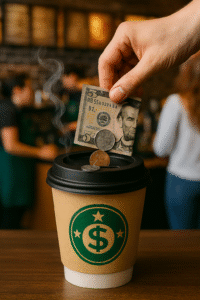
 Personal finance often feels overwhelming, dominated by talk of six-figure salaries, complex investments, or retirement accounts. Yet one of the most transformative ideas in modern financial literacy is deceptively simple: the Latte Factor. Popularized by David Bach in The Automatic Millionaire and expanded in The Latte Factor with John David Mann, this concept reframes wealth-building not as a grand strategy but as a series of small, daily decisions.
The Latte Factor isn’t about demonizing coffee. It’s about recognizing that every dollar spent is a choice—and those choices compound over time. By becoming conscious of small habitual expenses, individuals can redirect money toward savings, investments, or debt repayment, unlocking long-term freedom.
What is the Latte Factor?
At its core, the Latte Factor refers to small, seemingly insignificant daily expenditures—coffee, snacks, bottled water, rideshares, streaming subscriptions—that add up over months and years.
- Example: A $5 latte each day equals $150 per month, or $1,800 per year.
- Long-term impact: Invested at a reasonable annual return, that $5/day can grow meaningfully over decades due to compounding.
The brilliance of the Latte Factor lies in its accessibility. It doesn’t require advanced financial knowledge or a high income. It simply asks: Are you aware of where your money is going?
The storytelling approach
In The Latte Factor, Bach uses a fictional narrative to illustrate the concept. The protagonist, Zoey, is a young professional struggling financially despite working hard. Through conversations with a mentor named Henry, she learns three secrets of financial freedom:
- Pay yourself first: Prioritize savings before spending.
- Make it automatic: Automate transfers to savings or investments.
- Live rich now: Financial freedom isn’t deferred; it’s built through daily choices.
This narrative makes the Latte Factor relatable. Readers see themselves in Zoey’s struggles and realize that small adjustments can create profound change.
Why the Latte Factor resonates
The Latte Factor has inspired many because it reframes financial discipline as empowerment rather than deprivation.
- Accessibility: Anyone can start today, regardless of income.
- Psychological impact: It shifts focus from scarcity (“I can’t afford it”) to agency (“I choose where my money goes”).
- Compounding effect: Small savings can grow exponentially when invested consistently.
It’s not about cutting out joy. It’s about conscious trade-offs. If a daily latte brings happiness, keep it—but recognize that it comes at the cost of other goals.
Critiques and counterpoints
While the Latte Factor is compelling, critics argue it can oversimplify financial struggles.
- Structural costs matter more: Housing, healthcare, and transportation often dwarf small discretionary spending.
- Not everyone spends on lattes: Many households already live frugally, with little room to cut.
- Risk of guilt: Overemphasis on micro-spending can create shame rather than empowerment.
These critiques highlight an important nuance: the Latte Factor is a starting point, not a complete solution. It builds awareness, but larger strategies must also address big-ticket expenses.
Applying the Latte Factor in daily life
The real power of the Latte Factor lies in its application. Here are practical steps that translate awareness into action:
- Track micro-spending: Use a simple journal or budgeting app to identify unconscious expenses.
- Redirect funds: Automate transfers equal to your “latte” spend into savings or investments.
- Create rituals: Treat each spending decision as a threshold—honoring your capital instead of letting it slip away.
- Balance joy and discipline: Keep the purchases that truly matter, cut the ones that don’t.
For example, if you spend $10/day on takeout lunches, redirecting half of that into savings could yield $1,800 annually. Over decades, that becomes transformative.
The Latte Factor as a ritual of sovereignty
Beyond finance, the Latte Factor can be reframed as a daily sovereignty audit. Each $5 decision is a micro-threshold: do you let it dissolve into autopilot, or compost it into expressive agency?
For those seeking autonomy—whether in housing, digital platforms, or personal freedom—the Latte Factor becomes symbolic. It’s not about coffee; it’s about reclaiming small acts as portals to sovereignty. Every redirected dollar becomes a gesture toward independence, privacy, and long-term vision.
Compound interest in action
Let’s illustrate with a simple scenario:
- Daily latte ($5): $150/month → $1,800/year.
- Invested consistently: Over long horizons, disciplined contributions combined with compounding can grow substantially.
This demonstrates the exponential power of compounding. What feels trivial today becomes meaningful tomorrow when repeated and invested over time.
Living rich now
One of Bach’s most important insights is that financial freedom isn’t about waiting until retirement. By practicing the Latte Factor, individuals can live rich now—not through luxury, but through peace of mind.
- Freedom from debt: Small redirections accelerate payoff timelines.
- Confidence in savings: Automatic contributions build resilience.
- Joy in conscious spending: Choosing intentionally aligns daily life with long-term values.
This mindset shift is as valuable as the money itself.
Conclusion
The Latte Factor is more than a financial tip; it’s a philosophy. It teaches that small choices matter, awareness is power, and compounding is magic. While it doesn’t replace systemic solutions or address every financial challenge, it empowers individuals to reclaim agency over their money.
Whether you’re saving for retirement, paying off debt, or building sovereignty in your life, the Latte Factor reminds you: You are richer than you think.