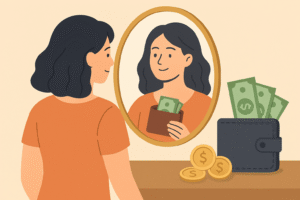
 Money is more than numbers in a bank account. It’s a mirror that reflects how we see ourselves, how others perceive us, and how we navigate the world. Financial status often becomes intertwined with self‑image: success can inflate confidence, while setbacks can erode self‑esteem. Yet this relationship is not fixed. With awareness and deliberate practice, anyone can reshape how finances influence identity.
🌍 Introduction: The Mirror of Money
Money is never just about transactions. It’s a cultural symbol, a psychological anchor, and often a silent judge of self‑worth. A promotion, a new house, or a debt‑free milestone can boost confidence. Conversely, overdue bills or financial instability can erode self‑esteem. Yet this relationship is not destiny. Self‑image—the way we see ourselves—can be reshaped, and financial status can be reframed as a tool rather than a verdict.
🪞 Part I: Understanding Self‑Image
Self‑image is the internal portrait we carry of ourselves. It influences confidence, resilience, and relationships. Psychologists break it into three dimensions:
- Internal self‑image: How we perceive ourselves.
- External self‑image: How we believe others perceive us.
- Ideal self‑image: Who we aspire to be.
A healthy self‑image allows people to face challenges without collapsing into shame. A fragile one makes individuals vulnerable to external markers—like financial status.
Exercise: Journal about your current self‑image. Write down three words you’d use to describe yourself today, and three words you’d like to embody in the future.
💵 Part II: The Financial Dimension of Identity
Money is rarely neutral. It symbolizes security, freedom, and status. Owning a home or wearing designer clothes often signals achievement. Debt or unemployment can feel like personal shortcomings—even when they’re circumstantial.
Humans are wired to compare. Financial status becomes a visible metric—salary, possessions, lifestyle—that fuels comparison. Social media amplifies this, showcasing curated lifestyles that distort reality.
Exercise: List five ways you compare yourself financially to others. Then reframe each comparison into a value‑based statement (e.g., “I don’t own a big house” → “I value simplicity and freedom from debt”).
⚠️ Part III: The Risks of Linking Self‑Image Too Closely to Finances
- Emotional Vulnerability: Financial setbacks can feel like identity collapse.
- Distorted Identity: Overvaluing possessions while neglecting creativity or kindness.
- Relationship Strain: Money stress often leads to conflict or isolation.
- Perpetual Dissatisfaction: The “hedonic treadmill” keeps benchmarks moving, leaving people unsatisfied.
Reflection: Think of a time when money stress affected your self‑esteem. How could you reinterpret that moment as a lesson rather than a verdict?
🔄 Part IV: How the Relationship Can Be Changed
- Reframe Money Narratives: Replace limiting beliefs with empowering ones (“My worth is not my wealth”).
- Build Financial Literacy: Learn budgeting, saving, investing to gain confidence.
- Separate Worth from Wealth: Anchor identity in values, creativity, and relationships.
- Celebrate Incremental Wins: Small victories compound into stability and self‑esteem.
- Seek Support: Therapy or coaching can untangle self‑esteem from money.
Exercise: Write down one limiting money belief. Cross it out and replace it with a new empowering statement. Place it somewhere visible.
🛠️ Part V: Practical Framework for Change
Here’s a ritual framework to reshape self‑image while navigating financial thresholds:
- Step 1: Awareness – Journal about money beliefs.
- Step 2: Reframe – Replace limiting beliefs with empowering ones.
- Step 3: Small Wins – Set achievable goals and celebrate progress.
- Step 4: Anchor Identity Beyond Money – Create rituals affirming worth outside finances.
- Step 5: Build Skills – Learn financial literacy tools.
- Step 6: Seek Support – Share progress with allies or professionals.
📖 Part VI: Stories of Transformation
Case Study 1: A young professional burdened by debt reframed it as resilience, celebrating small repayments and rebuilding self‑image. Case Study 2: A wealthy executive felt inadequate until therapy helped him anchor identity in creativity and relationships. Case Study 3: A teacher with modest income managed money wisely, built savings, and contributed to her community, strengthening self‑image.
🌐 Part VII: The Cultural Dimension
Consumer culture equates worth with possessions. Social media amplifies comparison. Counter‑movements like minimalism and financial independence challenge the wealth‑equals‑worth narrative, offering healthier frameworks for identity.
Exercise: Audit your social media feed. Unfollow accounts that trigger unhealthy comparison. Replace them with value‑driven or educational content.
🕰️ Part VIII: Long‑Term Strategies
- Financial Independence: Build security to reduce anxiety.
- Value‑Driven Living: Align spending with values, not status.
- Mindfulness: Practice gratitude to reduce comparison.
- Education: Teach children healthy money narratives.
✅ Conclusion: Rewriting the Story
The relationship between self‑image and financial status is powerful but not permanent. Money can shape identity, but it doesn’t define worth. By reframing narratives, building skills, celebrating wins, and anchoring identity beyond wealth, anyone can change the story. Self‑image is the foundation of resilience. Financial status is a tool, not a mirror. When we separate the two, we reclaim sovereignty over our identity and create a healthier, more empowered relationship with money.