A Lesson in Stewardship
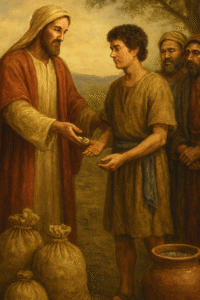 The parable of the three talents, found in Matthew 25:14–30, is one of the most enduring stories in the Christian tradition. It is deceptively simple: a master entrusts his servants with varying amounts of wealth before leaving on a journey. Upon his return, he evaluates how each servant has managed what was given. Yet beneath this narrative lies a profound lesson about stewardship—the responsibility to use wisely the gifts, opportunities, and resources entrusted to us.This post explores the parable in detail, unpacks its symbolism, and reflects on how stewardship remains a vital principle for modern life, leadership, and community.
The Parable Retold
A wealthy master prepares to leave on a long journey. Before departing, he entrusts three servants with his wealth:
- To the first, he gives five talents.
- To the second, he gives two talents.
- To the third, he gives one talent.
In the ancient world, a talent was not a skill but a unit of currency—an enormous sum of money, equivalent to years of wages. The master’s trust was significant.
The first servant invests his five talents and doubles them to ten. The second does likewise, turning two into four. But the third servant, fearful of losing what little he had, buries his single talent in the ground.
When the master returns, he praises the first two servants: “Well done, good and faithful servant. You have been faithful over a little; I will set you over much. Enter into the joy of your master.” The third servant, however, is condemned as lazy and unworthy. His talent is taken away and given to the one with ten.
Stewardship as Faithful Responsibility
The parable is not merely about money—it is about stewardship. Each servant was entrusted with something valuable, and each had a choice: to use it productively or to waste it.
- Stewardship means accountability. The master’s return symbolizes divine judgment, reminding us that we are accountable for how we use our lives.
- Stewardship means courage. The first two servants took risks, investing boldly. The third servant acted out of fear, and his caution became his downfall.
- Stewardship means growth. The expectation was not preservation but multiplication. Gifts are meant to expand, not stagnate.
This principle applies to every sphere of life. Whether we are entrusted with wealth, skills, influence, or relationships, stewardship calls us to nurture and grow what we have been given.
Stewardship in Modern Life
The parable’s wisdom extends far beyond its biblical context. In today’s world, stewardship manifests in multiple dimensions:
Stewardship of Resources
We live in a time of abundance and scarcity side by side. Stewardship challenges us to manage resources responsibly—whether financial, environmental, or technological. Just as the servants were judged by their use of talents, societies are judged by how they use their wealth and innovations. Waste, exploitation, or hoarding reflects poor stewardship. Investment in sustainability, equity, and shared prosperity reflects faithful stewardship.
Stewardship of Gifts and Skills
Every person has unique talents—skills, creativity, intellect, or empathy. To bury these gifts out of fear or complacency is to squander them. Stewardship calls us to cultivate our abilities, share them generously, and use them to uplift others. The parable reminds us that gifts are not given for self-preservation but for contribution.
Stewardship of Communities
Leadership is a form of stewardship. Leaders are entrusted with people, visions, and institutions. The parable warns against leaders who bury opportunities, clinging to fear or inertia. Faithful stewardship in leadership means investing in people, fostering growth, and multiplying opportunities for others.
The Fear That Buries Talents
The third servant’s failure is rooted in fear. He feared the master’s expectations, feared loss, and feared risk. His response was paralysis.
This fear resonates today. Many bury their talents—whether creative, professional, or spiritual—because of fear of failure, criticism, or inadequacy. Yet the parable insists that fear is not an excuse. Stewardship requires courage. To risk is to honor the trust placed in us. To hide is to betray it.
Stewardship as a Communal Practice
While the parable focuses on individual servants, stewardship is also communal. The talents entrusted to us are not for personal gain alone but for the flourishing of others.
- In families: Stewardship means nurturing children, relationships, and traditions.
- In workplaces: Stewardship means mentoring, innovating, and creating environments where others thrive.
- In society: Stewardship means advocating for justice, protecting the vulnerable, and ensuring that collective resources serve the common good.
The parable’s conclusion—where the talent is taken from the fearful servant and given to the fruitful one—illustrates that resources gravitate toward those who use them well. Communities thrive when stewardship is practiced faithfully.
Stewardship and Spiritual Growth
The parable also speaks to spiritual life. Faith itself is a gift entrusted to believers. To bury it—keeping it private, unused, or stagnant—is to miss its purpose. Faith grows when exercised, shared, and lived out. Stewardship of spiritual gifts means engaging in prayer, service, and witness, multiplying the impact of divine grace in the world.
Lessons for Today
- We are entrusted with something valuable. Life itself is a gift, along with the skills, opportunities, and relationships we hold.
- We are expected to use it. Preservation is not enough; growth is the goal.
- Fear is the enemy of stewardship. Courage and risk are necessary to honor the trust placed in us.
- Accountability is inevitable. Just as the master returned, we too will be called to account for how we lived.
- Stewardship is communal. Our gifts are meant to bless others, not just ourselves.
Stewardship in Practice: A Modern Parable
Imagine three entrepreneurs entrusted with seed funding.
- The first invests boldly, creating a business that employs dozens and uplifts a community.
- The second builds steadily, creating a sustainable enterprise that doubles its impact.
- The third hides the money in a vault, fearful of risk.
When the investors return, they celebrate the first two for multiplying opportunity and condemn the third for wasting potential. This modern retelling shows that stewardship is not about wealth alone but about courage, creativity, and responsibility.
Conclusion: The Joy of Stewardship
The parable of the three talents is ultimately a story of joy. The faithful servants are invited into the master’s joy—a symbol of fulfillment, belonging, and divine approval. Stewardship is not a burden but a pathway to joy. When we use our gifts courageously, invest in others generously, and grow what we have been given faithfully, we enter into a deeper joy that transcends fear and stagnation.
Stewardship as Our Calling
The story of the three talents reminds us that stewardship is not optional—it is our calling. Each of us has been entrusted with something precious. The question is not whether we have enough but whether we will use what we have.
Faithful stewardship transforms fear into courage, scarcity into abundance, and responsibility into joy. It is the heartbeat of the parable and the invitation of life itself: to take what we have been given and multiply it for the good of all.