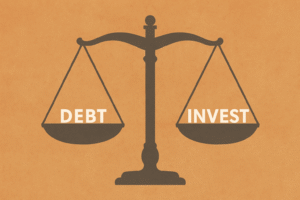
 In the quiet ache of financial uncertainty, one question echoes louder than most:
Should I invest while I’m still in debt?
It’s not just a budgeting dilemma. It’s a ritual threshold. A moment where agency, shame, hope, and sovereignty collide. And for many, it’s the first true rehearsal of legacy logic—where every dollar becomes a declaration.
This post isn’t just about numbers. It’s about emotional congruence. It’s about reclaiming clarity in the face of inherited scripts. And it’s about designing a financial path that honors both your present repair and your future expansion.
Let’s walk it slowly.
🔍 The Emotional Landscape of Debt
Debt is rarely just a number. It’s a story. A wound. A contract—sometimes signed in desperation, sometimes inherited, sometimes ritualized through silence.
- Credit card balances whisper shame.
- Student loans echo promises that didn’t deliver.
- Medical debt carries trauma.
- Payday loans scream urgency.
Before we even touch investing, we must name the emotional terrain. Because if we skip this step, we risk layering strategy on top of rupture—and that leads to misalignment.
Debt is not failure.
It’s a signal. A map. A prompt for repair.
🧭 The Three Financial Forces
To decide whether to invest while in debt, we must understand the three forces at play:
- Interest Rate Gravity
Debt grows. Investments grow. But they grow at different speeds. If your credit card charges 25% interest and your investments earn 7%, you’re losing ground. That’s gravity. - Emotional Momentum
Paying off debt can feel like reclaiming power. Investing can feel like planting seeds. Both are emotionally potent—but they serve different cycles. - Time Horizon
Debt is often short-term pain. Investing is long-term gain. The tension between urgency and patience is where most people get stuck.
⚖️ The Core Question: Which Comes First?
Let’s ritualize the decision. Not as a binary, but as a layered inquiry.
✳️ Step 1: What Kind of Debt Are You Holding?
| Debt Type | Typical Interest Rate | Emotional Weight | Strategic Priority |
|---|---|---|---|
| Credit Cards | 15–30% | High | Pay off first |
| Student Loans | 3–7% | Medium | Depends |
| Mortgage | 2–6% | Low | Invest alongside |
| Medical Debt | Varies | High | Negotiate + Repair |
| Payday Loans | 300–500% | Extreme | Emergency priority |
Sources:
If your debt carries high interest and high emotional weight, it’s often wise to prioritize payoff. Not just for financial reasons—but for emotional clarity.
✳️ Step 2: Do You Have an Emergency Fund?
Investing while vulnerable is like building a house on sand. Before you invest, ask:
- Do I have 1–3 months of expenses saved?
- Can I handle a surprise bill without spiraling?
If not, pause. Build your emergency fund first. This is your ritual of safety.
✳️ Step 3: What’s Your Emotional Goal?
Are you investing to:
- Escape?
- Prove something?
- Build legacy?
- Rehearse agency?
Be honest. Investing from desperation leads to volatility. Investing from clarity leads to congruence.
🧮 The Math of It
Let’s say you have:
- $5,000 in credit card debt at 20% interest
- $500/month to allocate
You could:
- Pay off debt aggressively: Save ~$1,000/year in interest
- Invest in the market: Earn ~$350/year at 7% return
Conclusion: Paying off high-interest debt is often the better financial move. It’s a guaranteed return. It’s emotional repair.
But…
🌱 The Case for Investing While in Debt
There are exceptions. And they matter.
1. Employer Match on Retirement Accounts
If your employer offers a 401(k) match, that’s free money. Even if you’re in debt, contributing enough to get the match is often wise. It’s a ritual of leverage.
2. Low-Interest Debt
If your debt is below 5% interest, and you have emotional bandwidth, investing can make sense. Especially if you’re building long-term wealth.
3. Emotional Repair Through Forward Motion
Sometimes, investing—even a small amount—creates a sense of expansion. A break in the shame cycle. A rehearsal of future clarity.
If $25/month into an index fund helps you feel sovereign, it might be worth it. Ritual logic matters.
🧘♂️ Designing a Ritual Interface
Let’s imagine a beginner-friendly interface that honors this tension.
🔄 Toggle: “Debt vs. Investing”
- Left side: Payoff logic, interest rates, emotional weight
- Right side: Investment growth, legacy rehearsal, emotional expansion
🪙 Coin Feedback
- Every debt payment triggers a “repair coin”
- Every investment triggers a “legacy coin”
🧭 Slider: “Emotional Priority”
- Safety → Repair → Expansion
- User selects where they are emotionally, and the interface adjusts recommendations
🔁 Undo Logic
- Every gesture is reversible
- Users can reallocate funds with full clarity
This isn’t just budgeting. It’s ritual architecture.
🧠 Cognitive Biases to Watch For
Investing while in debt often triggers:
- Optimism bias: “I’ll earn more than I pay in interest”
- Present bias: “I want results now”
- Loss aversion: “I’m afraid to miss out”
Naming these helps. They’re not flaws. They’re signals.
📜 Legacy Rehearsal: A New Frame
Imagine this:
- Every debt payment is a refusal to stay small
- Every investment is a rehearsal of future clarity
You’re not just moving money. You’re rewriting your story.
🛠️ Practical Framework: The 3-Bucket System
Let’s ritualize your monthly cash flow.
Bucket 1: Safety (Emergency Fund)
- Goal: 1–3 months of expenses
- Symbol: Shield
Bucket 2: Repair (Debt Payoff)
- Goal: Eliminate high-interest debt
- Symbol: Hammer
Bucket 3: Expansion (Investing)
- Goal: Build long-term wealth
- Symbol: Seed
Each month, allocate based on emotional and financial priority. Adjust as needed. Celebrate every gesture.
🧭 Sample Flow for Beginners
Let’s say you have $500/month to allocate.
- $200 → Emergency fund (until full)
- $200 → Credit card payoff
- $100 → Roth IRA (index fund)
This honors safety, repair, and expansion. It’s emotionally congruent. It’s reversible. It’s sovereign.
🧘♀️ Emotional Anchors to Use
- “I am not my debt. I am my repair.”
- “Every dollar I move is a declaration.”
- “I invest not to escape, but to expand.”
- “I pay off debt as a ritual of refusal.”
These aren’t affirmations. They’re contracts.
🧩 When Investing While in Debt Makes Sense
| Scenario | Invest? | Why? |
|---|---|---|
| High-interest credit card debt | No | Payoff is higher ROI |
| Low-interest student loan | Maybe | Depends on emotional bandwidth |
| Employer 401(k) match available | Yes | Free money |
| No emergency fund | No | Build safety first |
| Emotional need for forward motion | Maybe | Small investing can help |
Sources:
🧱 Building a Ritualized Financial System
Let’s go beyond budgeting.
Design a system that:
- Honors emotional cycles
- Offers symbolic feedback
- Allows reversibility
- Tracks legacy gestures
- Marks boundaries and refusals
This isn’t just money. It’s meaning.
🧨 Closing the Loop
So, should you invest while in debt?
There’s no universal answer. But here’s the ritual logic:
- If your debt is high-interest and heavy—repair first.
- If your debt is low-interest and you have safety—expand slowly.
- If you’re emotionally stuck—ritualize small gestures of forward motion.
Every dollar is a vote. Every gesture is a rehearsal. Every decision is a declaration.
You are not behind. You are in process.
🪞 Final Reflection
Debt is not a shame spiral.
It’s a compost pile.
And investing is not a trophy.
It’s a seed.
You get to choose how you move.
You get to design your interface.
You get to rehearse your legacy.
And when you do it with clarity, reversibility, and emotional congruence—you’re not just managing money.
You’re building a sanctuary.